
Applying for graduate or entry-level roles is tough. It's even tougher when you're targeting startups that may not have established early-career programmes or clear pathways for junior talent.
There's a common perception that startups are run by twenty-somethings who don't care about institutional experience - that they'd much rather you show up ready to learn and adapt in a fast-paced environment. And while there's some truth to that, it doesn't give startups a free pass on getting entry-level transparency right.
Creating clarity for junior candidates doesn't require elaborate corporate programmes or polished corporate copy. It just takes some time and care. Startups should lay out what opportunities actually exist and what they do to foster junior talent. They should share real information and insights about growth, mentorship, and what early-career employees can expect.
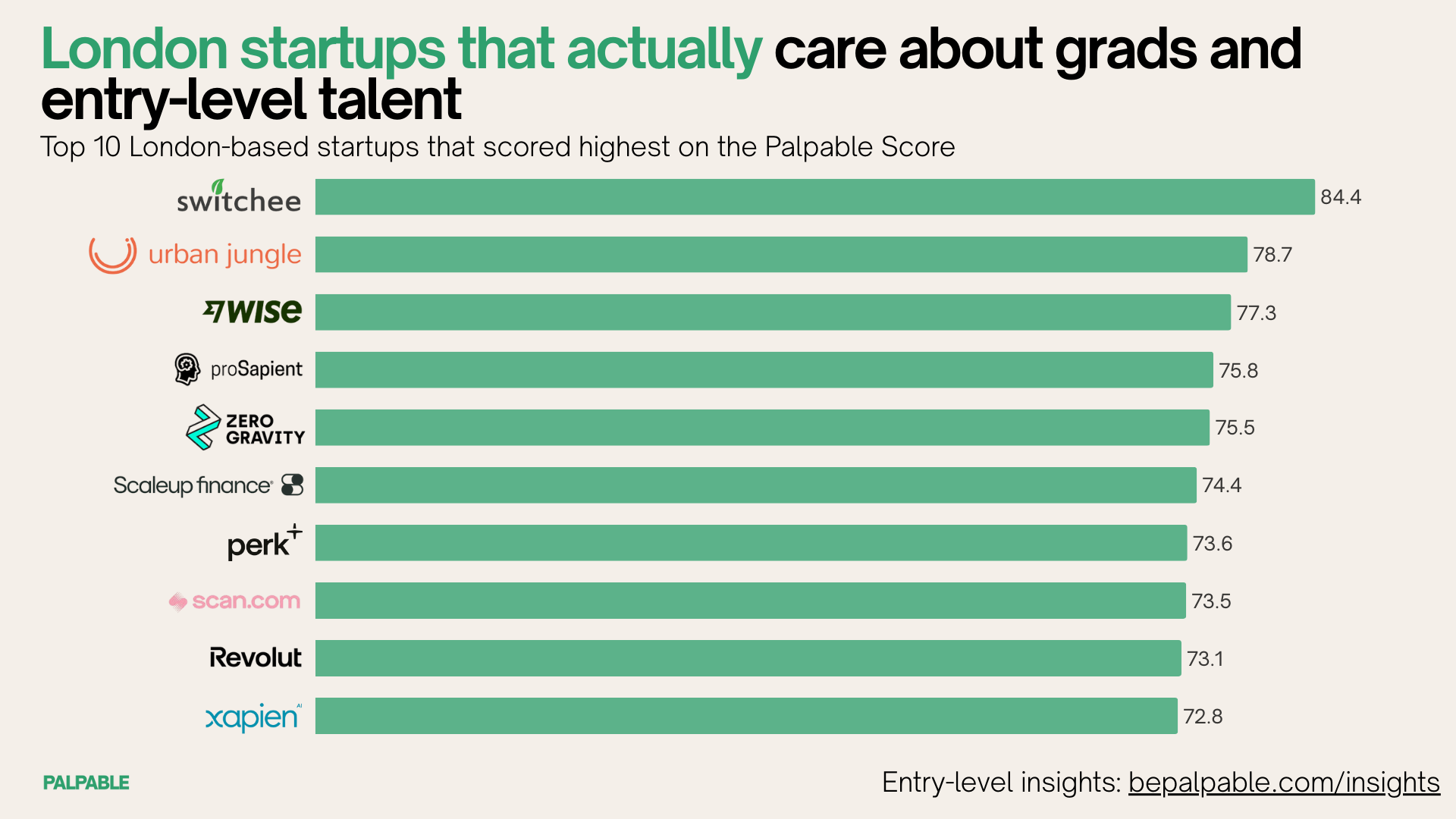
Yes, the formalities might look different at a startup. But showing you genuinely care about developing junior talent? That's universal - and it starts with being transparent. So the Palpable team set out to rank startups in London who really care about entry-level talent and analyse what they’re doing differently from the majority of startups. Here’s what we found:
Being good for graduates and junior hires isn't about being nice or offering free snacks. It's about being designed for people who are still learning the ropes.
The best startups for entry-level talent do four things consistently well:
Tell you what they're looking for – No vague job descriptions or mystery criteria. You know what skills matter and why.
Show you how to prepare – They give you resources, examples, or guidance so you can actually put your best foot forward.
Give you a real shot – Your application gets evaluated fairly, not filtered out by arbitrary requirements or keyword scanners.
Don't waste your time – They communicate clearly, stick to timelines, and respect your effort with meaningful feedback.
Most startups manage one or two of these. The standout companies do all four, every time. If you want to know more about how we score companies on entry-level talent hiring, feel free to check out this post where we lay out the methodology behind the Palpable Score.
1. Switchee (84.4): Clear, structured hiring with a step-by-step recruitment plan, plus explicit onboarding and progression. They also publish salary ranges often, which removes guesswork for entry-level candidates. They’re also a B Corp so if you’re looking for careers with an impact, Switchee’s already on it.
2. Urban Jungle (78.7): Strong true-junior pathways and a clearly explained process, backed by formal training and support once you join. They also share pay and progression details more openly than most startups.
3. Wise (77.3): Multiple genuine early-career entry points with published application/interview guidance that helps you prepare properly. Wise also pairs this with structured programmes and visible pay information.
4. proSapient (75.8): Entry-level roles are clearly positioned (with dedicated early-careers visibility) and the hiring process is made more legible than average. The “intensive training” framing and clear pay anchoring reduce uncertainty for first-job candidates.
5. Zero Gravity (75.5): One of the clearest smaller organisations for early-career candidates: explicit steps, expectations, and strong guidance. Support signals are strong too (e.g., development budget and clear internal progression indicators).
6. Scaleup Finance (74.4): Real junior pathways with role context that makes it easier to understand what you’ll actually do and learn. Stronger-than-average clarity on progression and what early-career growth looks like.
7. Perk (73.6): Multiple credible early-career routes plus a structured process (especially for engineering) that reduces ambiguity. They also signal stability and internal development, which matters a lot if you’re picking your first “serious” role.
8. Scan.com (73.5): Very clear about what junior candidates are assessed on, and explicit about candidate experience (including anti-ghosting intent). Salary ranges for early-career roles and “how we work” clarity help candidates self-select confidently.
9. Revolut (73.1): Strong programme structure (timelines, stages, and what to expect) across internships and grad pathways, with clearer recruiter communication than most. Pay details for early-career programmes are also more explicit than the London startup norm.
10. Xapien (71.9): Xapien stands out for giving junior candidates clear job responsibilities and expectations up front, with interview stages that are easy to understand and prepare for.
What do these companies have in common? They've stopped treating entry-level hiring like a lottery and started treating it like a long-term investment.
They explain their processes clearly, invest meaningfully in developing junior talent, and create genuine opportunities for people without extensive CVs to prove themselves.
Not every company gets it right. Some London startups still make it unnecessarily hard to break in, especially if you're early in your career.
These companies scored lowest on the Palpable Score:
Candidates at these companies are more likely to encounter unclear expectations, unpredictable interview processes, long silences after applying, and systems that feel designed for insiders rather than people trying to get their foot in the door.
If you're just starting out, that's not just frustrating - it's a genuine barrier to opportunity.
Picking a startup to join as your first career decision is a bold move. It comes with uncertainty, ambiguity, and often a steep learning curve. But it can also be incredibly rewarding - if you choose wisely. The key is finding startups that are transparent about what they offer junior talent. These companies give you tangible advantages that make the inherent risks worth taking.
The startups that get this right might not have fancy graduate schemes or glossy recruitment brochures. But they've done the work to make entry-level roles real opportunities - not just cheap labor dressed up as "learning experiences."
Next time you're researching where to apply, don't just ask yourself: "Is this a cool startup?"
Ask: "Is this a startup that actually cares about someone like me?"
That's exactly what the Palpable Score helps you answer.
Looking for your next role?
Explore over 1000 companies that have been Palpable scored. Search here >
💚 Find companies that invest in entry-level talent, not just experienced hires.