
Let's be honest: early-career hiring gets lumped into frustratingly vague labels. "Junior roles." "Graduate positions." "Entry-level opportunities." But what does that actually mean?
When you analyze real job postings at scale—not just career advice blogs or LinkedIn thought pieces—you see exactly what employers are hiring for and what they expect from candidates like you.
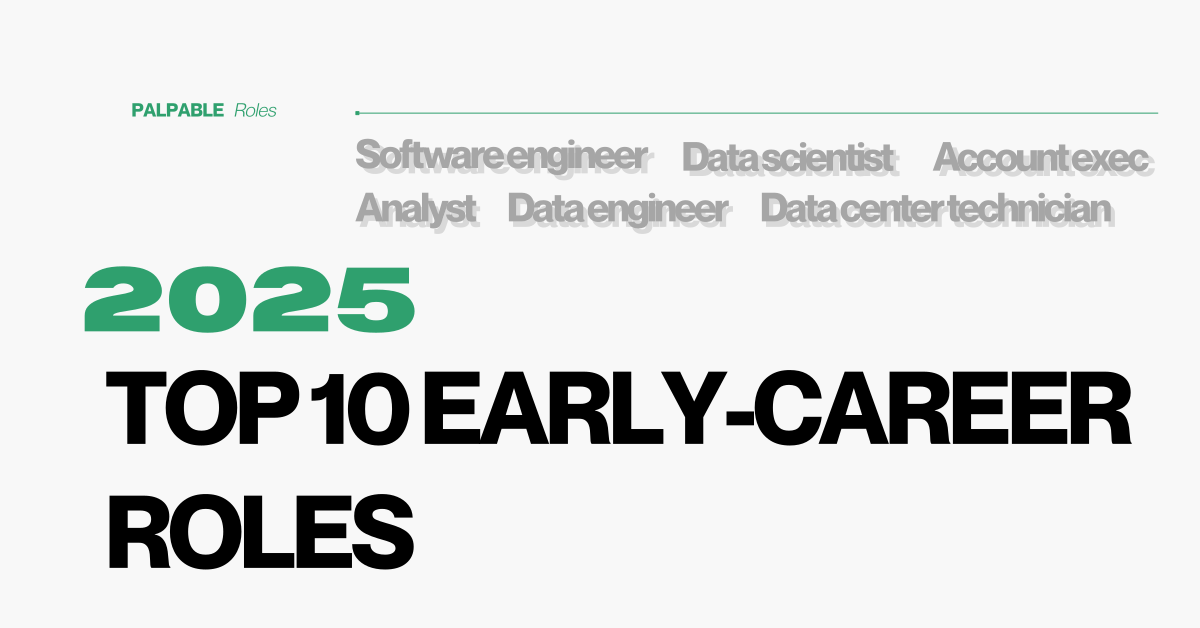
We dove into 11,000+ early-career job listings, grouped similar titles (because "Software Engineer I," "Software Engineer II," and "Junior Software Engineer" are basically the same role), and identified the ten positions that consistently dominate the market.
This isn't theory. This is what's actually out there right now.
For each role, we'll break down what the job actually entails, what early-career versions look like in practice, the titles you'll see in job boards, the requirements that keep showing up, and real companies that are hiring.
Let's get into it.
Software engineers build and maintain the software behind products and internal systems—everything from customer-facing apps to backend services, APIs, and platform tooling. The work is usually team-based: you're shipping features, improving reliability, reviewing code, and iterating based on product needs.
Here's something that surprises a lot of new grads: early-career engineers are rarely "shadowing." You'll usually start with scoped features and bug fixes, then move into owning components, writing tests, participating in code review, and learning system architecture. Progress tends to be measured on execution, code quality, and how well you work with others.
Coinbase, Goldman Sachs, Microsoft, Google
Data scientists use data to answer business questions, build predictive models, and support decisions in product, operations, or strategy. In many organizations, the job is less "research lab" and more "applied problem-solving with real constraints."
Early-career data scientists typically spend a lot of time cleaning datasets, building analyses, running experiments, prototyping models with existing libraries, and translating results into decisions. Being able to explain "what this means" matters as much as technical skill.
BCG, Procter & Gamble (P&G), Caterpillar, Stripe
Data engineers build the plumbing that makes data usable: pipelines, ingestion, transformation, warehouse modelling, and reliability. If analysts and data scientists are "drivers," data engineers build the roads.
You'll typically work on existing pipelines first: monitoring, fixing data quality issues, improving reliability, adding new data sources, and documenting datasets. A big part of the job is making data trustworthy and reproducible.
MSCI, Scotiabank, Barclays (London), Amazon
"Analyst" is a broad category—business, risk, research, strategy, finance, operations. The core job is structured thinking: turning messy questions into clear analysis and recommendations.
Early-career analysts often build models, create reports, clean data, answer stakeholder questions, and support decision-making cycles. You'll usually be judged on accuracy, clarity, and how reliably you can deliver useful outputs.
Visa, S&P Global, JPMorganChase, Royal Bank of Canada (RBC)
Data center technicians keep the physical infrastructure behind cloud computing running: servers, networking, cabling, power/cooling, and hardware troubleshooting. This work underpins everything from streaming to AI compute.
Early-career roles are hands-on and operational: hardware swaps, rack/stack, incident response, monitoring, and preventative maintenance. Many roles are shift-based and emphasize safety, procedure, and reliability.
CoreWeave, Singtel Group, Hudson River Trading, Ecolab
Account executives (AEs) close deals. In B2B companies, they manage sales cycles: discovery calls, demos, objections, negotiation, and contracts—often working closely with SDRs, solutions engineers, and customer success.
Early-career AEs often start with smaller accounts or mid-market segments, with structured targets and coaching. The job is performance-driven, but progression can be fast if you can build pipeline and close.
ServiceNow, Samsara, Canva, Connectd
SDRs generate qualified opportunities for the sales team through prospecting, outreach, lead qualification, and meeting-setting. It's the top of the commercial funnel—and one of the most common early-career entry points.
You'll spend most days prospecting (cold email/call/LinkedIn), qualifying leads, writing outreach sequences, and learning how to run discovery conversations. Metrics matter: activity, meetings booked, pipeline created.
Deel, Databricks, Salesforce, AT&T
Ops roles make organizations run better: improving processes, coordinating teams, tracking performance, supporting launches, and removing bottlenecks. It's a "make things work" function.
Early-career ops roles are broad: you'll handle reporting, project support, documentation, process mapping, and cross-team coordination. They're often a strong springboard into strategy, leadership, or product.
Bolt, Bank of America, Via Transportation, Wise
Product roles define what gets built, why, and how success is measured. Product teams sit between users, the business, and engineering—shaping direction and prioritization.
Early-career product roles often support senior PMs: writing requirements, analyzing usage data, conducting research, coordinating launches, and aligning stakeholders. The job is more communication-heavy than many candidates expect.
Apollo, Ares Management, Intercontinental Exchange (ICE), Nucor
Relationship and client roles focus on retaining and growing existing customers through service, trust, and long-term account management. They're common in finance, insurance, and B2B services.
Early-career hires often support account managers: handling client requests, coordinating internally, tracking performance, and resolving issues. You're measured on responsiveness, accuracy, and relationship quality.
Interactive Brokers, Marsh McLennan, ICONIQ, Bajaj Finance
These ten roles represent the bulk of what's actually available in the early-career job market right now. Notice what they have in common: communication skills, the ability to work with messy information, and evidence that you can learn and deliver under real constraints.
The market isn't just looking for technical skills in isolation. It's looking for people who can work with others, explain their thinking, and operate in environments where not everything is perfectly defined.
If you're job hunting, use this as a reality check. Focus your energy on the roles that are actually being hired for—and make sure your resume, projects, and interview prep align with what employers are consistently asking for.
The jobs are out there. Now you know what they actually look like.