
Landing your first real job shouldn't feel like a gamble. Yet for too many graduates and career-changers, the early-career job market feels like a black box: opaque hiring processes, vague role descriptions, and little sense of whether a company will actually invest in your growth or just churn through junior talent.
That's the problem that Palpable Jobs has always set out to solve. Our team spent 2025 analysing the early-talent programmes of dozens of global organisations, looking past the glossy recruitment marketing to find companies that genuinely invest in new hires. The result? A ranked list of the top 20 employers based on five concrete pillars: early-career access, hiring fairness and transparency, learning and support, pay fairness and stability, and early-career outcomes.
At Palpable Jobs, we didn't just count how many interns a company hires. We dug into whether organisations offer structured entry routes like internships, apprenticeships, and graduate schemes. We checked if companies publish clear interview processes so you're not guessing what to prepare for. We looked for mentorship programmes, formal learning opportunities, pay transparency, and real support for long-term career mobility.
Each company receives a Palpable Score out of 100. Every employer on this list earned their spot by demonstrating they're not just recruiting talent - they're building it. Curious about the ins and outs of our methodology - click here.
Here's how the rankings shake out:
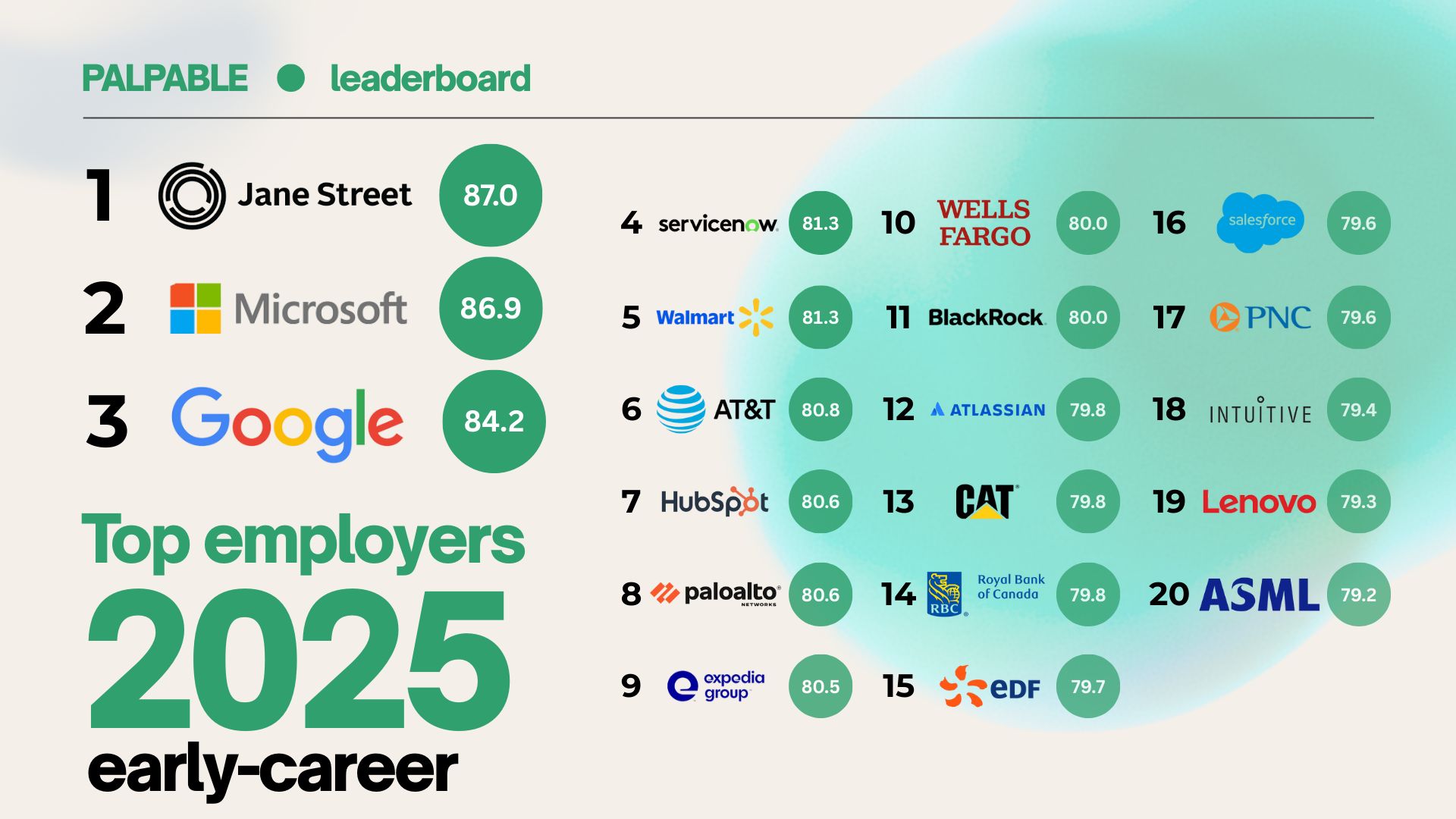
What's striking about this list isn't just who's on it, but the diversity. Tech giants sit alongside traditional manufacturers, energy companies neighbour fintech firms, and retail stands shoulder-to-shoulder with cybersecurity. Great early-career programmes aren't confined to Silicon Valley - they're everywhere.
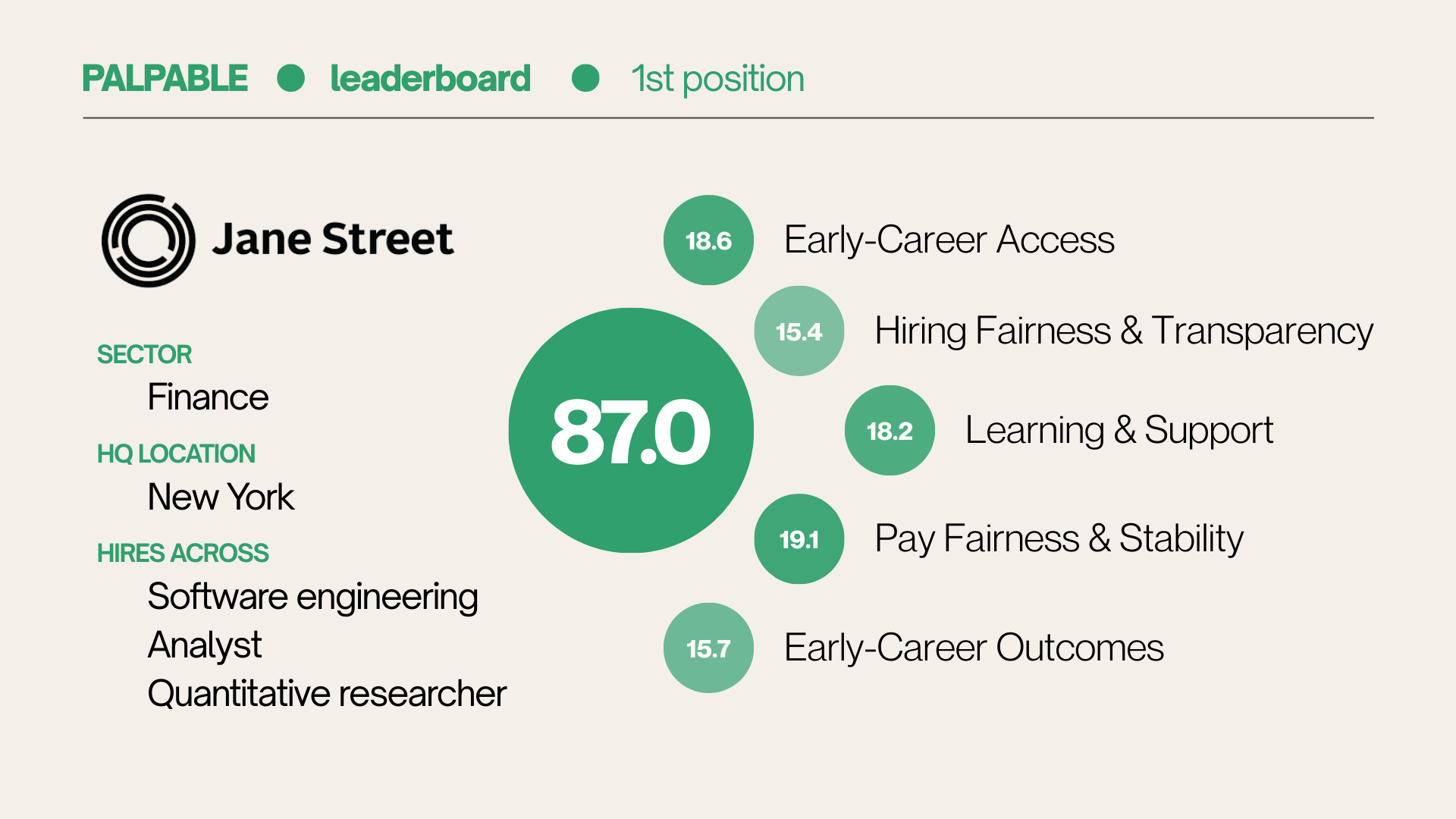
Jane Street topped the rankings, and it's not hard to see why. The quantitative trading firm runs multiple speciality programmes - JSIP, INSIGHT, IN FOCUS, SEE, and AMP - that go far beyond typical internships. It's skill-building classes, real mentorship, and actual projects that matter.
But here's what really sets them apart: they promise every single application is reviewed by a human, and every applicant gets a response. In an age of automated screening, AI hiring and radio silence (we've all been there!), that's radical transparency. This is one of the most techno-optimistic companies saying, "hey, we still care about human ingenuity."
The pay doesn't hurt either. Software engineering roles in New York start at $200,000–$300,000. They also offer no-cost medical coverage and 12 weeks of fully paid parental leave. For interns, they cover housing, travel, and meals, plus provide generous scholarships.
view Palpable profile ->
Microsoft's approach to early talent is comprehensive. Their Explore Microsoft internship welcomes first- and second-year students who might not even know what they want to do yet. The Leap apprenticeship offers an alternative to traditional degrees. The Aspire Experience gives recent graduates a structured 1+ year journey with mentorship, networking, and immersive learning.
What Microsoft gets right is the long game. Programs like their three-year MCAPS EiP show they're thinking about your career trajectory, not just next quarter's headcount. They've also embraced salary-range transparency in the U.S., publish compensation ranges for many roles, and offer competitive stock awards.
Interns consistently note strong conversion rates to full-time positions, which tells you the company is using internships as genuine talent pipelines, not cheap labor.
view Palpable profile ->
Google's Build Your Future hub is a one-stop shop directing students into internships, apprenticeships, research placements, and their Engineering Residency program. Whether you're a traditional CS major or taking a non-linear path, there's likely a route in.
The hiring process stands out for its rigor and fairness. Google uses structured interviews and a hire-by-committee approach where multiple people review feedback from interviewers. This prevents any single manager from making unilateral decisions and reduces bias. Their own research shows that teams with divergent opinions make better hiring choices.
Once you're in, programs like the Engineering Residency and g2g peer-learning network ensure continuous mentorship and training. Salary ranges appear on many U.S. postings, supplemented by bonuses and equity, though transparency varies internationally.
view Palpable profile ->
ServiceNow's dedicated Early Careers hub offers 3–6 month internships across the U.S., Asia-Pacific, and Europe with a published "How We Hire" page that walks you through their prescriptive interview process. No guessing games. Employee reviews highlight strong intern-to-full-time conversion rates, and the projects are real - not busywork.
Don't sleep on Walmart. Their 10-week undergraduate internship feeds directly into rotational programs like the 24-month Accounting & Finance Development Programme, complete with mentorship and leadership exposure. The careers portal tracks your application status in real-time, removing that awful "did they get my resume?" uncertainty. Competitive hourly pay, stock purchase discounts, and 401(k) matching provide financial stability from day one.
AT&T's Early Careers hub offers clear entry points: a Technology Development Program, B2B Sales Development Program, and Summer Internship Program ranging from ten weeks to three years. The hiring process follows a repeatable pattern: screening, assessment, structured interviews, background checks, so you know what's coming. Development program associates get benefits immediately, and internal mobility into senior roles is common.
HubSpot's Emerging Talent programs span engineering, sales, marketing, product management, legal, and risk. They outline a step-by-step hiring journey with application review targets and decision timelines, and they'll even give you feedback calls after later interview stages if you request them. The benefits? Unlimited vacation and robust mental-health support signal they're thinking about you as a whole person, not just a productivity unit.
Palo Alto Networks' LEAP Programme includes internships, new-grad roles, and academy-style training covering product management, threat intelligence (Unit 42), sales, and systems engineering. Cohort-based training, mentorship, and access to certification resources help you build marketable skills. The company has recently scaled its early-career intake and emphasizes full-time placement at program end.
Expedia Group's programs run 8–14 weeks for internships, 12–24 months for graduate programs, and 12–18 months for apprenticeships. Graduates rotate through different teams, receive mentorship, and participate in leadership development workshops. Pay is competitive within the travel industry, and benefits like travel discounts and wellness stipends add to the appeal.
Wells Fargo's Early Careers catalog is comprehensive: undergraduate internships, graduate programs, and international talent routes across technology, finance, audit, and investment banking. Application windows and timelines are clearly published: CIB internship openings differ from other divisions, and they tell you that upfront. Interns rotate through business units, attend formal training, and benefit from 401(k) matches and employee stock purchase plans.
BlackRock runs global Summer Internship and Full-Time Analyst programs, plus 18-month apprenticeships for school leavers in the U.K. and Singapore. Their "How we hire" guide spells out the application, assessment, and interview formats in plain language, including case studies and group exercises. Compensation includes salary, annual bonus, and long-term incentives, though pay ranges aren't always posted. Alumni networks and internal mobility support progression into specialist roles.
RBC's flagship Amplify program bills itself as "not your typical internship", and they mean it. Cross-functional teams of students tackle bold challenges and pitch solutions all summer while receiving mentorship from senior executives and continuous learning support. The emphasis on teamwork, innovation, and leaving a mark attracts ambitious early-career talent. Competitive pay, full benefits, and relocation assistance reinforce financial stability, and many interns return as full-time employees.
PNC hires roughly 500 interns and 400 development-program associates each year across 11 programs. The 10-week Summer Internship and 12–36 month development programs cover finance, technology, and risk. The process is clear: application confirmation, recruiter screening, potential assessments or pre-recorded interviews, and live interviews. Here's an impressive stat: PNC fills approximately 60% of first-level and above roles with internal candidates, signaling strong internal mobility.
Atlassian's Early Careers track features summer internships and graduate programs with fixed intake dates. Their Early Careers Interview Guide outlines an assessment stage and three-to-four-interview loop, often virtual. Interns receive mentorship, participate in hackathons, and ship real features. The kicker? Atlassian's "Team Anywhere" remote-work policy adds flexibility and stability that's increasingly rare.
Salesforce's Futureforce internships and new-graduate roles provide mainstream entry points, while Future Pathways offers non-traditional routes through apprenticeships and partnerships with Year Up United and Ada Developers Academy. Their How We Hire guide invites candidates to request accommodations, including the option to object to automated screening tools, promoting fairness. The company reports converting up to 80% of eligible interns to full-time employees. Recent workforce reductions temper the outlook slightly, but the conversion rate speaks volumes.
Lenovo offers more than 300 internships globally and hires over 500 early-career employees annually. Programs include internships, rotational schemes, and the Scholar Network partnership expanding intern intake at U.S. sites. The company emphasizes fairness through online initial assessments for their EAGLeS graduate-hiring process, designed to support anonymity and inclusivity. Employees praise the ability to rotate across departments, gaining breadth early in their careers.
Caterpillar's Students & Graduates pipeline offers everything from high-school Student Trainee Programs to rotational programs for graduates in Engineering, Field Representative roles, Finance, IT, and Leadership & Technical Development. Program lengths and rotation schedules are published upfront. Pay is competitive for manufacturing, and benefits include tuition reimbursement and health coverage. The breadth of programs lets you explore different parts of the business before specializing.
EDF is creating 1,000 apprenticeships tied to high-profile projects like Hinkley Point C. Their recruitment journey for apprenticeships and graduate roles is transparent: online tests, telephone interviews, and assessment centres on set campaign dates. Apprentices receive pre-start activities, an outward-bound induction course, networking sessions, and support from career managers, placement managers, and buddies from previous intakes. They publish clear starting salaries: £35,000 for graduate roles, £24,500 for industrial placements, plus pensions and customizable benefits. Some graduate schemes lead directly to permanent roles and support chartership accreditation.
Intuitive hosts 10–12 week internships and co-ops through its Students & University program. Interns work on projects connected to the company's surgical-robotics mission and join a cohort of nearly 200 students from diverse schools. The hiring process is transparent: after application, candidates move through qualification screening, phone interviews, Zoom interviews, and offers. Onboarding includes social events and professional development workshops. Pay is competitive for med-tech, and benefits include relocation assistance.
ASML runs recurring internships and graduation assignments in the Netherlands (3–12 months) plus co-ops and internships across U.S. sites. Structured programs like the Management Traineeship and Career Gateway Programme provide coaching, training, and access to senior leaders. The selection flow is clear with status updates within two weeks, pre-recorded video interviews, and final interviews with feedback. Benefits in the Netherlands include a 13th-month payment, pension, and 40 days of paid leave. U.S. benefits include 401(k) matching and paid parental leave.
These 20 companies prove that recruiting early-career talent isn't just about filling junior roles: it's about building equitable pathways into rewarding careers. Each employer offers structured entry routes, transparent hiring processes, formal learning and mentorship, and competitive compensation. The diversity of sectors, from technology and finance to manufacturing and energy, shows that investment in early-career talent isn't confined to one industry.
The transparency on long-term outcomes still varies. Not every company publishes hard numbers on intern conversion rates or promotion timelines. But these employers set an encouraging benchmark for what's possible when organizations genuinely commit to developing the next generation of professionals.
If you're a student exploring internships or a graduate seeking a role with growth potential, these companies are leading the way. They're not perfect, but they're trying, and in an early-career market that often feels designed to frustrate and confuse, that counts for something.
Interested in who's hiring? Search through over 11,000 early-career roles listed on the Palpable Jobs board.
Keen to browse more insights about companies? Explore over 350 companies choosing to redefine early-career talent.